
Yoga is Meant for These Times
Feb 18, 2026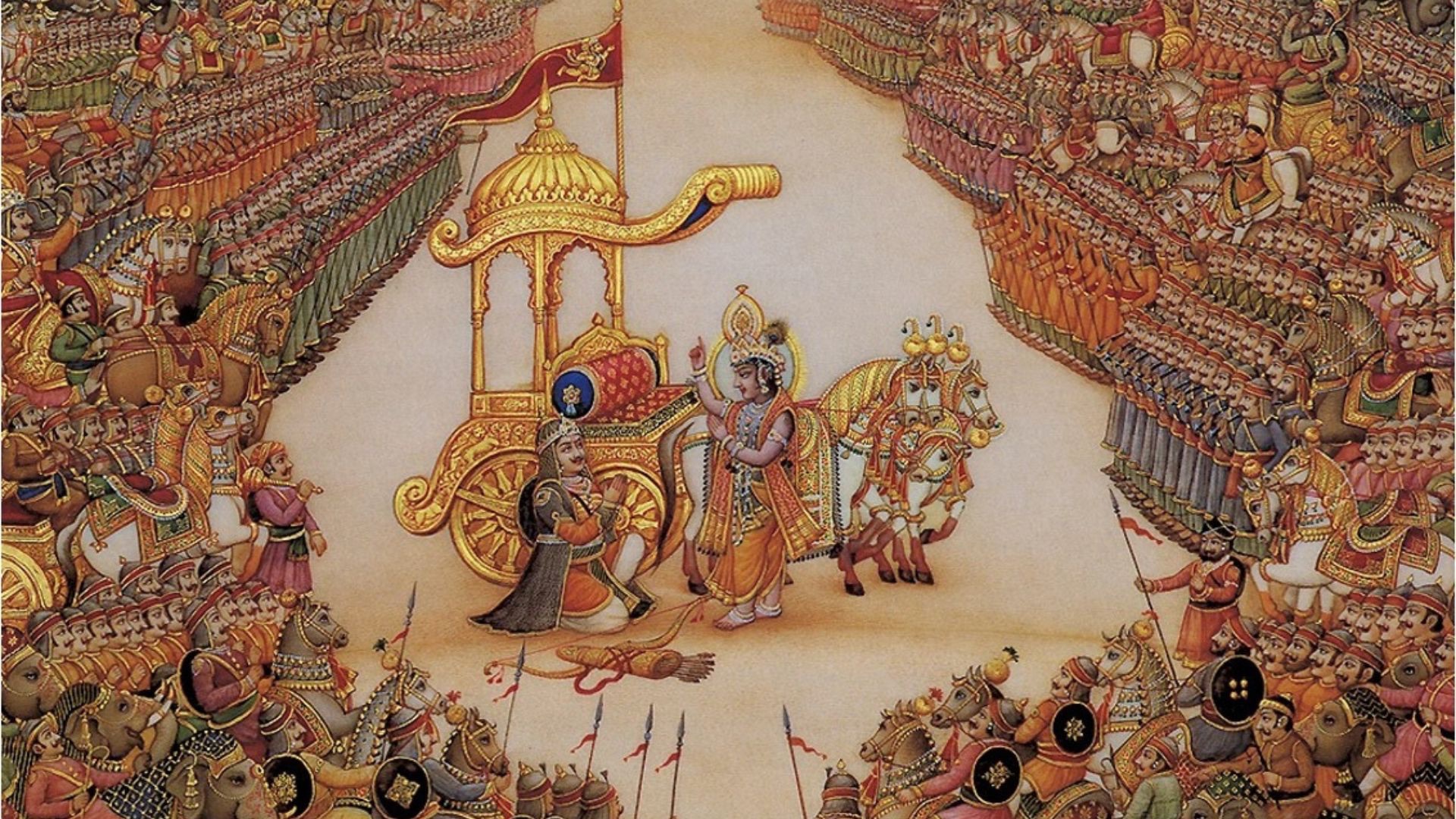
Yoga isn’t reserved for moments of peace and stillness, quiet mornings on the mat, or retreats far from the noise of the world. It was designed for times like these—times of turmoil, confusion, and fear, when the ground beneath us feels uncertain and the path forward unclear.
The teachings and practices of yoga were designed to address human suffering, and it is precisely in times of suffering that they are most alive and most needed.
The most famous yoga text in India, the Bhagavad Gita, opens with a hero in a terrible situation.
Arjuna—one of the greatest warriors of his time—stands frozen on the battlefield between two armies ready to engage. Before him is an unbearable choice: fight against enemies who include his teachers, relatives, and friends—or abandon his dharma, his sacred duty as a warrior. There is no clean solution, no easy way out.
His bow slips from his hand. His body trembles. His mind spins. Overwhelmed with anguish, he turns to Lord Krishna—the voice of wisdom—and pleads:
My will is paralyzed, and I am utterly confused.
Tell me which is the better path for me.
Let me be your disciple.
I have fallen at your feet; give me instruction.
— Bhagavad Gita 2.7 (Easwaran)
Krishna responds with a smile. From his vantage point, he sees both Arjuna's turmoil and his readiness to shift, his openness to a new possibility. The breaking down is also a breaking open. And this is where the magnificent, timeless teachings of the Bhagavad Gita begin.
This shift—from frozen with indecision to asking for help—tells us some important things about the role of yoga in tumultuous times:
When we surrender to not knowing, we become open to a new understanding. The turning point is not when Arjuna solves his dilemma—it’s when he admits he cannot. Likewise, it’s often when life pushes us to our limits and our usual strategies fail that we become ready to try something new. The certainty of the ego loosens its grip, and a deeper intelligence has room to enter. Yoga begins there.
Yoga is meant to serve us in times of crisis. Most of us came to yoga not because life was easy and smooth, but because of a challenge or difficulty—something hurt, or felt unstable or untenable, and we wanted help. The Bhagavad Gita affirms that the teachings and practices of yoga are designed to be applicable precisely when we need them most.
At the heart of Krishna's instruction is the notion of yoga as a state of equanimity—not as a kind of detached indifference, but as an inner steadiness that remains stable even as circumstances shift. He describes it as samatvam: evenness of mind. This isn’t the absence of feeling or the suppression of difficulty. It’s the capacity to remain rooted in a calm, steady awareness while moving through turbulent thoughts or painful emotions.
Krishna describes the person who embodies this quality—the sthitaprajna, or one of steady wisdom—as someone who meets the inevitable flux of life without being defined by it. This is the freedom yoga points toward: not a life without difficulty, but a life not held hostage by it.
When the mind is filled with confusion and fear, clarity doesn't come from thinking harder — it comes from this shift in perspective. By quieting the mind and learning to witness our thoughts rather than identify with them, we discover that beneath the turbulence there is something steady: a ground of being that holds us even in uncertainty. From here, grounded and purposeful action becomes possible.
Krishna doesn't tell Arjuna what to do, but by the end of the text the shift in his understanding empowers him to act with clarity and resolve:
My delusion is destroyed, and I have gained wisdom through your grace. I stand here with my doubts dispelled, ready to do your will.
— Bhagavad Gita 18.73 (Easwaran)
This is what practice offers us now. Whether it's taking three conscious breaths before reading the news, sitting in meditation to witness the storm of thoughts without getting lost in them, or moving through asana to remember that we are more than our racing minds—practice creates space. In that space, perspective expands and we rediscover inner steadiness as a source of clarity and renewed purpose.
The world will remain complex, and our dilemmas won't disappear. But we no longer stand on the battlefield alone, paralyzed. We stand more grounded in ourselves—and in what we are here to do.
Yoga is meant for now.