
Who Stands With You?
Apr 29, 2026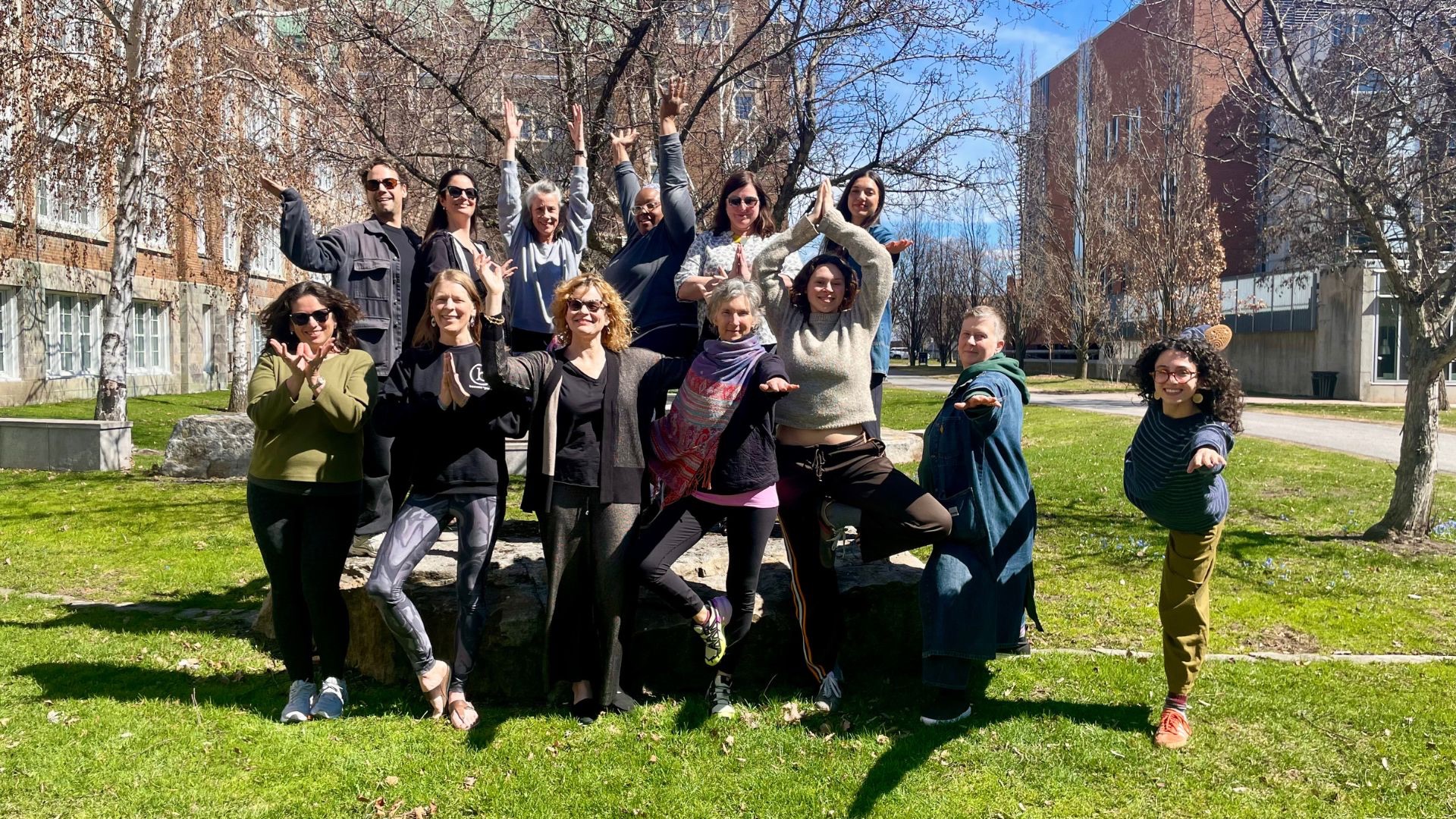
There’s a saying that a problem can’t be solved at the level at which it was created — it requires a new level of awareness.
I always interpreted this to mean taking a bird’s eye view of a situation to gain perspective and discover solutions that wouldn’t otherwise be apparent.
But after the culminating weekend of our nine-month teacher training, I’m understanding this in a new way.
When I look out on the state of our world these days, my instinct is still to zoom out and find hope on that distant horizon. But what if the new level of awareness we need isn’t found in a wider view, but in a more intimate one? What if inspiration isn’t somewhere “out there,” but right here in front of us? What if, instead of trying to rise above it all, we simply looked around?
That’s the shift I experienced this weekend.
I watched people who had come together nine months ago as strangers, spanning generations and life experiences, support each other with genuine care and celebration. When one of our students got a flat tire biking to the training on Sunday morning, someone immediately offered to pick her up so she could arrive on time. It was a small but meaningful moment that exemplified how yoga isn’t only a personal practice. It’s a relational one.
In Buddhist and yogic traditions, kalyana mitra refers to spiritual friendship: relationships rooted in goodwill, respect, and generosity. These are your well-wishers — companions on your path who support you not out of obligation, but by choice.
The physical postures, breathwork, and meditation are the architecture of yoga. But its relational dimension — the friendships and informal networks of support we cultivate over time — is equally essential. Supportive community, often known as the sangha or the kula, has always been understood as integral to a transformational yoga practice.
Being part of this kind of community is one of the most natural ways to cultivate mudita — a quality emphasized in both yogic and Buddhist traditions. It’s the capacity to take genuine joy in one another’s joy: to root for each other, to celebrate effort and growth. In practicing mudita, something subtle but powerful happens—we are changed by what we offer.
This is how yoga extends beyond the personal. We aren’t practicing only for ourselves, but for the effect we have on each other and through each other, on our communities and our world.
Buddhist scholar Joanna Macy once wrote that the world will be saved by people whose love for life is greater than their fear. Acknowledging all the wonderful humans I am in collaboration with, I know those people are already here — in your yoga class, in your neighbourhood, showing up for each other simply because it feels good and right to do so.
In these overwhelming times, maybe the new level of awareness we need isn’t about seeing more broadly but about seeing closer. Look around, notice who stands with you, and tend to those relationships. Your kalyana mitras may be nearer than you think — and they may be exactly the hope you've been looking for.